
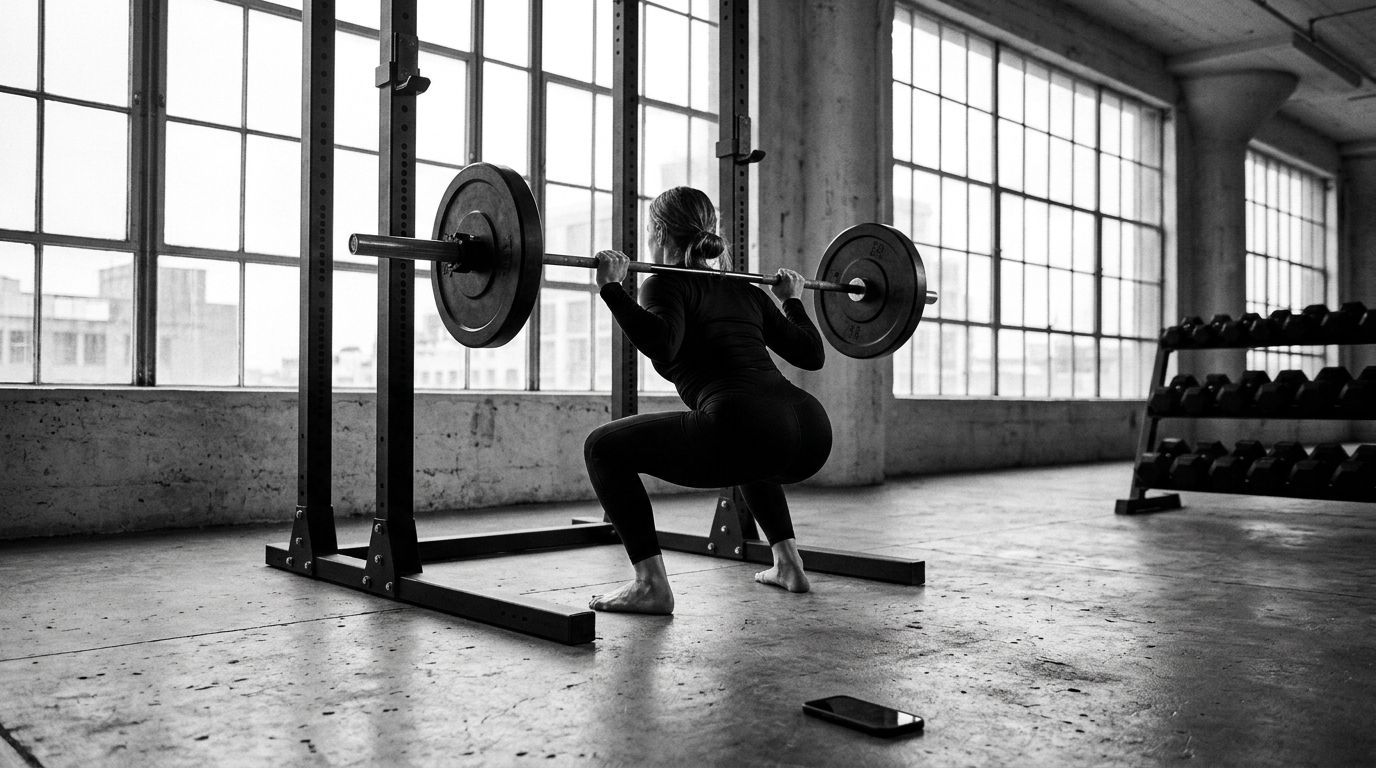
A full body workout 3 days a week trains every major muscle group in each session, on non-consecutive days such as Monday, Wednesday and Friday. Each muscle gets worked three times a week, and you get four days off to recover. It’s also forgiving: miss a session and nothing important goes untrained for the week.
This guide gives you the complete routine first. After that it explains why the structure works, how to progress, and what to do when life gets in the way.
The routine at a glance#
Three workouts (A, B and C) rotate across the week. Each takes roughly 60 to 80 minutes including warm-up, depending on how long you rest.
| Day | Workout | Main focus |
|---|---|---|
| Monday | A | Squat, horizontal push and pull |
| Wednesday | B | Hinge, vertical push and pull |
| Friday | C | Machine and dumbbell volume, plus an optional weak-point finisher |
Prefer weekends? Tuesday, Thursday and Saturday work just as well. The only rule is at least one rest day between sessions.
How to read the tables
- Sets × reps: 3 × 8–10 means three sets of 8 to 10 reps.
- RIR (reps in reserve): how many clean reps you could still do when you stop. 2 RIR means you stop with two reps left in the tank. This is a widely used way to gauge effort (Helms et al., 2016).
- Rest: time between sets. Supersets (6a and 6b) are done back to back.
Who this routine is for: beginners (use the two-week ramp-up below), returning lifters and intermediates who want a time-efficient plan.
Who should check first: if you have a heart or blood pressure condition, are pregnant, are recovering from an injury, or haven’t exercised in years, talk to a doctor or qualified coach before starting. Stop any set that causes sharp or joint pain.
---
Workout A (Monday): Squat and horizontal push/pull#
| # | Exercise | Sets × reps | RIR | Rest |
|---|---|---|---|---|
| 1 | Barbell back squat | 3 × 6–8 | 2 | 2.5–3 min |
| 2 | Incline dumbbell press (30°) | 3 × 8–10 | 2 | 2 min |
| 3 | Chest-supported dumbbell row | 3 × 8–10 | 2 | 2 min |
| 4 | Lying or seated leg curl | 3 × 10–12 | 1–2 | 90 sec |
| 5 | Cable or dumbbell lateral raise | 3 × 12–15 | 1 | 60–90 sec |
| 6a | Incline dumbbell curl | 2 × 10–12 | 1 | none |
| 6b | Rope triceps pushdown | 2 × 10–12 | 1 | 60 sec |
Workout B (Wednesday): Hinge and vertical push/pull#
| # | Exercise | Sets × reps | RIR | Rest |
|---|---|---|---|---|
| 1 | Trap bar deadlift (or dumbbell Romanian deadlift) | 3 × 5–6 | 2 | 3 min |
| 2 | Flat barbell bench press | 3 × 6–8 | 2 | 2.5 min |
| 3 | Neutral-grip pull-up (or lat pulldown) | 3 × 6–8 | 2 | 2 min |
| 4 | Standing dumbbell overhead press | 3 × 8–10 | 2 | 2 min |
| 5 | Bulgarian split squat | 3 × 8–10 per leg | 2 | 90 sec |
| 6 | Standing calf raise | 2 × 12–15 | 1 | 60 sec |
| 7 | Hanging knee raise (or cable crunch) | 2 × 12–15 | 1 | 60 sec |
Workout C (Friday): Machines, dumbbells and weak points#
| # | Exercise | Sets × reps | RIR | Rest |
|---|---|---|---|---|
| 1 | Leg press (or hack squat) | 3 × 10–12 | 2 | 2 min |
| 2 | Seated cable row (close grip) | 3 × 10–12 | 2 | 90 sec |
| 3 | Flat dumbbell press | 3 × 8–10 | 2 | 2 min |
| 4 | Dumbbell Romanian deadlift | 3 × 10–12 | 2 | 2 min |
| 5 | Lean-away dumbbell lateral raise | 3 × 12–15 | 1 | 60 sec |
| 6 | Weak-point finisher (optional, see menu below) | 2 × 10–15 | 1 | 60 sec |
Form cues for the main lifts
- Back squat: brace your core, push your knees out over your toes, and keep your whole foot on the floor.
- Incline and flat dumbbell press: lower with control until you feel a stretch across the chest. Keep your elbows roughly 45 to 60 degrees from your torso rather than flared wide, which is kinder to the shoulders.
- Chest-supported row and cable row: lead with the elbows and squeeze the shoulder blades together without shrugging.
- Trap bar deadlift: pull the slack out of the bar, push the floor away, and finish standing tall without leaning back.
- Romanian deadlift: push your hips back, keep the weight close, and stop when your hamstrings are stretched, not when your back rounds.
- Bench press: shoulder blades back and down, feet planted, bar touching low on the chest.
- Pull-up or pulldown: start by pulling your shoulder blades down, then drive your elbows toward your ribs.
- Overhead press: squeeze your glutes and ribs down so you press up, not back.
- Bulgarian split squat: lean slightly forward and keep the front foot flat.
The 5-minute warm-up
- 2 minutes of easy cardio (bike, rower or brisk walk).
- 1 minute of hip and upper-back mobility, such as the world’s greatest stretch, 5 reps per side.
- 1 minute of activation: band pull-aparts and glute bridges.
- Then 2 to 3 progressively heavier warm-up sets of your first lift before your working sets.
---
New to lifting? The two-week ramp-up#
The full routine asks a lot of a first-timer. Ease in:
- Weeks 1 and 2: do 2 sets per exercise (skip the finisher) and use weights you could lift for 3 to 4 more reps (3 to 4 RIR). The goal is learning the movements, not fatigue.
- Week 3 onward: move to the full sets and reps with 2 RIR.
- Swap the harder lifts: use goblet squat or leg press for the back squat, lat pulldown for the pull-up, dumbbell Romanian deadlift for the trap bar deadlift, and reverse lunges for the Bulgarian split squat.
Finding a starting weight: after warming up, pick a weight you think is light and do one set of the target reps. If you could have done 4 or more extra reps, add 5 to 10 percent and try again next set. If you struggled to hit the bottom of the range, drop the weight. It’s normal to need two or three sessions to settle each lift.
---
How much volume does this routine actually deliver?#
Here is the honest weekly count of direct sets, meaning sets where that muscle is the main mover:
| Muscle group | Direct sets per week | Also trained indirectly by |
|---|---|---|
| Chest | 9 | Overhead press, triceps work |
| Back and lats | 9 | Deadlifts, curls |
| Quadriceps | 9 | Leg curl days, split squat balance |
| Hamstrings | 6 | Trap bar deadlift |
| Glutes | none direct | Squats, deadlifts, split squats, leg press |
| Side delts | 6 | Overhead press |
| Biceps | 2 | All rows and pull-ups |
| Triceps | 2 | All pressing |
| Calves | 2 | Little |
| Abs | 2 | Squats and deadlifts (bracing) |
What this means in practice: chest, back and quads sit at a solid moderate dose. Arms, calves and abs are at a maintenance-to-modest level unless you pick them as your finisher. That’s a deliberate trade for sessions that stay under about 80 minutes. If you have the time and your progress stalls, adding one set to the exercises you most want to grow is the simplest next step, and it’s backed by the research below. For a deeper look, read our guide to how many sets per muscle per week.
---
Why a 3-day full body split works#
Frequency: train each muscle at least twice a week
A 2016 systematic review and meta-analysis of 10 studies (Schoenfeld, Ogborn and Krieger) found that, when weekly volume was equated, training a muscle twice a week produced better hypertrophy than once a week. The authors concluded that major muscle groups should be trained at least twice weekly, and said it remains undetermined whether three times beats two.
So be wary of anyone who claims three sessions a week is proven superior. The real advantage of a 3-day full body split is practical. Every muscle clears the twice-a-week bar with room to spare, and the structure is easy to maintain.
Volume matters too
In a randomized trial of 34 resistance-trained men (Schoenfeld et al., 2019), groups did 1, 3 or 5 sets per exercise, three sessions a week for 8 weeks. Strength and endurance gains were similar across groups, but muscle growth followed a dose-response pattern, with higher volumes producing greater gains.
Two takeaways. First, if your main goal is strength or you’re short on time, a moderate volume like this routine’s works well. Second, if maximum muscle size is the goal and you recover well, you’ll likely get more by adding sets over time. It’s a single 8-week study in men, so treat it as a guide rather than a law.
The protein synthesis window
After a hard session, muscle protein synthesis rises and stays elevated for a while. In a classic study of eight untrained volunteers (Phillips et al., 1997), synthesis was up 112 percent at 3 hours, 65 percent at 24 hours and 34 percent at 48 hours. That fits a pattern of training each muscle every 2 to 3 days.
A caution: that study was small and used untrained people, and lab measures of protein synthesis don’t map neatly onto long-term growth. We use it as supporting context, not as proof that this split beats others.
How it compares with other splits
| Split | Gym days | Times each muscle is trained | Best for |
|---|---|---|---|
| 3-day full body | 3 | 3× per week | Busy lifters, beginners, anyone who values flexibility |
| 4-day upper/lower | 4 | 2× per week | People who want more sets per muscle and have the time |
| 5- to 6-day body-part or push/pull/legs | 5–6 | 1–2× per week | Experienced lifters with plenty of time |
More gym days make it easier to fit in more total weekly sets, which matters for growth. A 3-day plan can match them only with longer sessions. If you want to compare formats, see our complete guide to workout splits.
---
Scheduling, missed days and rest days#
Shift, don’t skip
Most people lose weeks of training to one missed workout. Don’t. If Wednesday falls apart, move Workout B to Thursday, do Workout C on Saturday, and start the next week with A on Monday. Because every session trains the whole body, a shifted workout never leaves a muscle behind.
Plan for it: keep the order A, B, C and keep at least one rest day between sessions when you can. If you miss two sessions in a row, restart at the workout you skipped and skip nothing else.
What to do on rest days
Rest days don’t need to be strict. A daily walk, easy cycling or a few minutes of mobility work is plenty. Aim for movement you enjoy rather than a step target, and keep it easy enough that it doesn’t cut into your next session.
---
Progressive overload: double progression#
If you lift the same weight for the same reps every week, your muscles have no reason to change. Double progression is a simple, widely used way to add load gradually:
- Add reps first. Keep the weight the same and work toward the top of the rep range on every set.
- Then add weight. Once you hit the top of the range on all sets, increase the weight next session and start the range over.
Example for incline dumbbell press, target 3 × 8–10:
| Week | Weight | Set 1 | Set 2 | Set 3 | Next step |
|---|---|---|---|---|---|
| 1 | 30 kg (66 lb) | 10 | 9 | 8 | Stay at 30 kg |
| 2 | 30 kg (66 lb) | 10 | 10 | 9 | Stay at 30 kg |
| 3 | 30 kg (66 lb) | 10 | 10 | 10 | Increase the weight |
| 4 | 32 kg (70 lb) | 8 | 8 | 7 | Work back up to 10s |
In practice, smaller jumps (1 to 2.5 kg) suit upper-body and isolation lifts, while lower-body lifts can take slightly bigger jumps. Your numbers will differ.
Keep some reps in reserve
For squats, deadlifts and presses, stop with 1 to 2 reps left. Grinding to failure on heavy compounds tires you out for the rest of the session and adds injury risk without a clear benefit. On isolation exercises like lateral raises or curls, going to or close to failure on the last set is reasonable.
When you stall
If you can’t add reps or weight for 3 to 4 sessions in a row:
- Check sleep, food and stress first. They’re the usual culprits.
- Use smaller jumps, such as 1 kg dumbbell increases or 1.25 kg plates.
- Add one set to the exercise you most want to improve.
- After 8 to 12 weeks on the same lift, swap it for a close variation.
Deloads
After 6 to 8 weeks of steady training, or earlier if joints ache, strength drops or you feel flat, take an easier week. A common approach is to keep the same exercises but cut the sets by a third to a half and lower the weights by about 10 percent. This is standard coaching practice rather than a rule from a single study.
How to know it’s working
- Your logged weights and reps are trending up over 4 to 6 weeks.
- Your bodyweight, measurements or photos change in the direction you want, checked every 4 weeks rather than daily.
- Your workouts feel manageable, not like a grind.
Track your sets without the notebook. FreakyFit lets you log weights and reps, use rest timers and follow double progression on your phone, so you always know what to beat next session.
---
Substitutions for a busy gym or home training#
| Exercise | Gym alternative | Dumbbell or home alternative |
|---|---|---|
| Barbell back squat | Hack squat or Smith machine squat | Goblet squat |
| Trap bar deadlift | Barbell Romanian deadlift | Dumbbell Romanian deadlift |
| Flat barbell bench press | Chest press machine | Flat dumbbell press |
| Neutral-grip pull-up | Lat pulldown | Band-assisted pull-up or a pulldown with bands |
| Standing dumbbell overhead press | Seated machine shoulder press | Half-kneeling dumbbell press |
| Bulgarian split squat | Walking lunge | Reverse lunge |
A single-arm dumbbell row works your back but is a horizontal pull, so it doesn’t fully replace a vertical pull like the pull-up. If you only have dumbbells, see our 3-day dumbbell-only workout plan.
Weak-point finisher menu
On Workout C, choose one option for each 6 to 8 week block. Do 2 sets of each exercise listed:
- Arms: cable overhead triceps extension and EZ-bar curl.
- Shoulders: chest-supported rear delt fly and cable Y-raise.
- Upper chest: low-to-high cable crossover.
- Glutes and calves: barbell hip thrust and standing calf raise.
---
Nutrition and recovery basics#
Protein. A systematic review and meta-regression of 49 studies and 1,863 participants (Morton et al., 2018) found that in protein supplementation trials, intakes above about 1.6 g per kilogram of bodyweight per day gave no further gain in fat-free mass. The confidence interval for that cutoff was wide, so a target of 1.6 to 2.2 g/kg a day is a sensible range. For a 75 kg person that’s roughly 120 to 165 g. Spread it across your meals instead of loading it into one.
Calories. To build muscle, many people do well with a small surplus, in the region of 200 to 300 calories above maintenance. To lose fat while keeping muscle, a modest deficit with protein near the top of the range is a common approach. These are practical starting points, so adjust based on how your weight and performance respond.
Sleep. Most adults do best with 7 to 9 hours. It’s the cheapest recovery tool you have.
---
Five mistakes that stall progress#
- Letting sessions balloon. Piling on extra exercises turns a 70-minute workout into a 2-hour slog and quality drops. Stick to the plan and add sets only when progress stalls.
- Heavy squats and heavy conventional deadlifts in the same session. Both load the lower back heavily. That’s why heavy squats live on Workout A, the deadlift on Workout B and a lighter Romanian deadlift on Workout C.
- Skipping the small stuff. Lateral raises and arm work are the first things lifters cut when short on time. Supersets (curls with pushdowns) let you keep them in about 60 seconds of rest.
- Training to failure on every set. Keep 1 to 2 reps in reserve on compounds, as above.
- Changing exercises every week. You can’t track progress on a moving target. Stick with the same exercises for 8 to 12 weeks before swapping.
---
Frequently asked questions
Start this week#
- Pick your three days and put them in your calendar.
- Do the two-week ramp-up if you’re new, then run the full routine.
- Log every weight and rep.
- Eat enough protein and sleep.
- Stick with the same exercises for at least 8 weeks before judging results.
Ready to run it? Download FreakyFit to log this routine, follow your progression and see your numbers climb.
---
Sources#
- Schoenfeld BJ, Ogborn D, Krieger JW. Effects of Resistance Training Frequency on Measures of Muscle Hypertrophy: A Systematic Review and Meta-Analysis. Sports Medicine. 2016;46(11):1689–1697. PubMed
- Schoenfeld BJ, Contreras B, Krieger J, et al. Resistance Training Volume Enhances Muscle Hypertrophy but Not Strength in Trained Men. Medicine & Science in Sports & Exercise. 2019;51(1):94–103. PubMed
- Phillips SM, Tipton KD, Aarsland A, Wolf SE, Wolfe RR. Mixed muscle protein synthesis and breakdown after resistance exercise in humans. American Journal of Physiology–Endocrinology and Metabolism. 1997;273(1):E99–E107. PubMed
- Morton RW, Murphy KT, McKellar SR, et al. A systematic review, meta-analysis and meta-regression of the effect of protein supplementation on resistance training-induced gains in muscle mass and strength in healthy adults. British Journal of Sports Medicine. 2018;52(6):376–384. PubMed
- Helms ER, Cronin J, Storey A, Zourdos MC. Application of the Repetitions in Reserve-Based Rating of Perceived Exertion Scale for Resistance Training. Strength and Conditioning Journal. 2016;38(4):42–49. NSCA
---